The long-running contract dispute between actress and singer Ju Jingyi and her former agency Siba Media has once again drawn widespread public attention, with the conflict now stretching over a year and a half and still awaiting a definitive legal resolution.
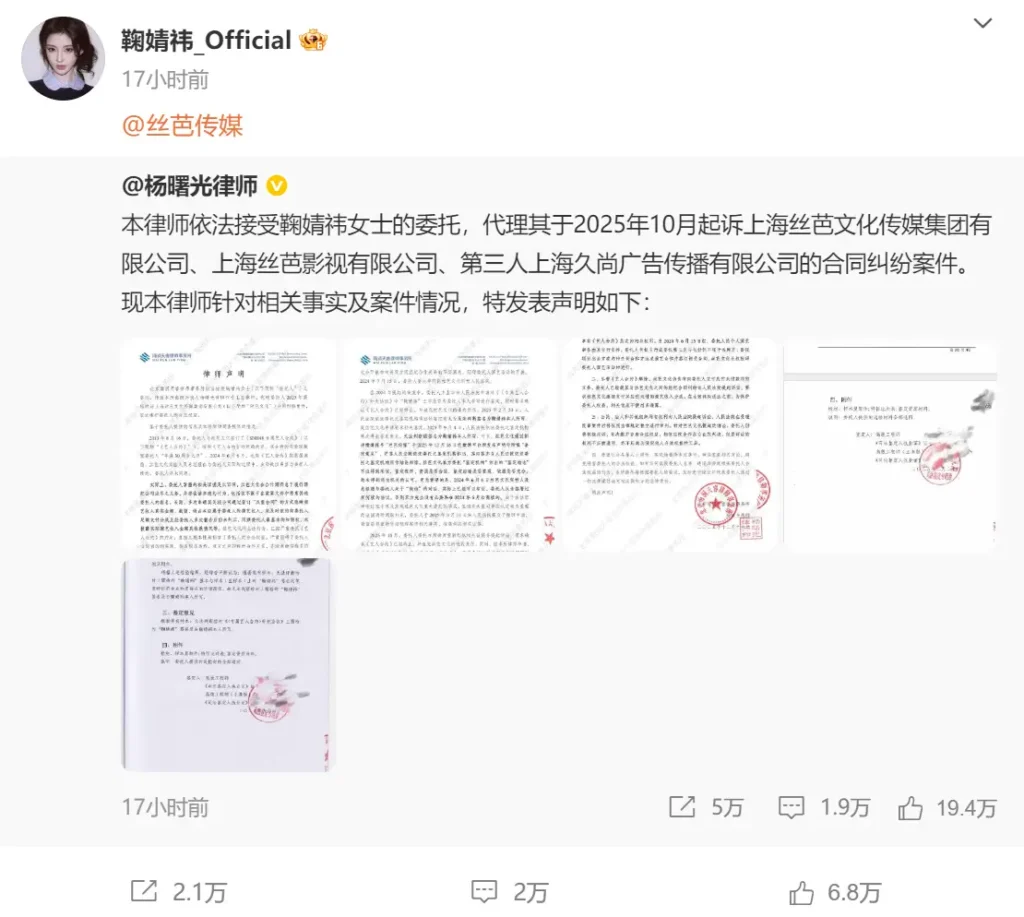
The latest wave of controversy was triggered by a statement released by Siba Media on December 16. In the announcement, the company disclosed the progress of ongoing legal proceedings, asserting that a forensic appraisal confirmed the authenticity of Ju Jingyi’s signature on a supplementary exclusive artist contract signed on September 10, 2018. Siba stated that the appraisal report would be formally submitted to the court, directly refuting Ju Jingyi’s claim that the signature was not her own.
Later that evening, Ju Jingyi’s studio responded by sharing a statement from her legal representatives, rejecting Siba Media’s interpretation. According to the statement, the appraisal did not conclusively determine that the signature belonged to Ju Jingyi, and legal action has been initiated to confirm the termination of the artist contract and pursue liability for breach of contract. Ju Jingyi’s side reiterated that the agency relationship had already ended as of June 15 of the previous year, with her professional activities now managed independently.
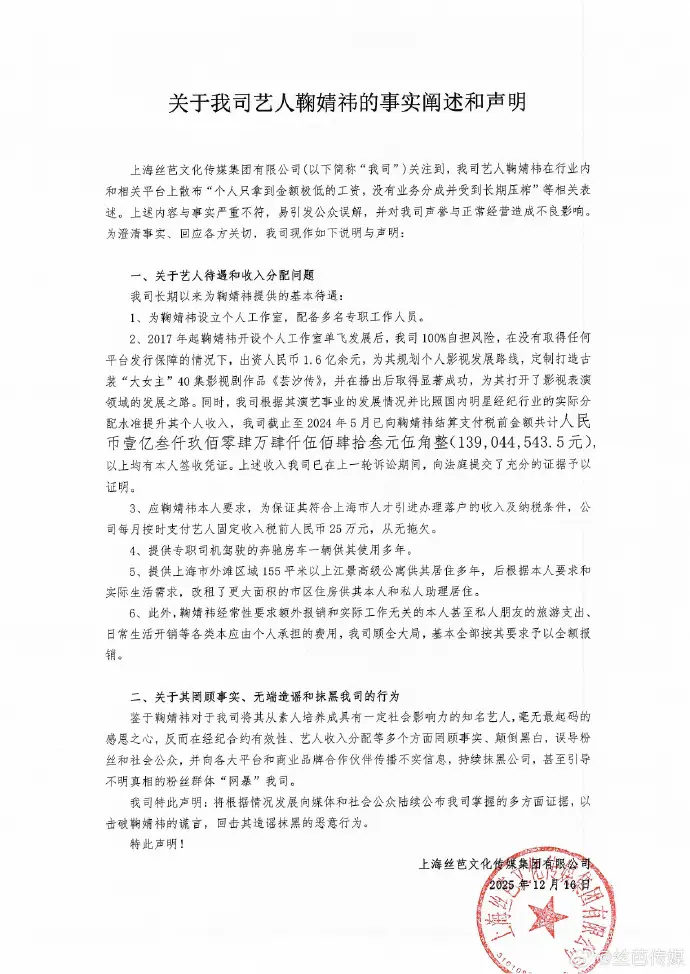
Siba Media subsequently released another statement, providing detailed financial figures to demonstrate what it described as substantial investment and compensation during the partnership. The agency claimed to have invested approximately 160 million yuan in Ju Jingyi’s career development, including the production of key projects such as “Legend of Yunxi.” By May 2024, it stated that a total of around 139 million yuan in pre-tax income had been settled with Ju Jingyi. The company also cited fixed monthly salary payments, dedicated staff, vehicles, housing, and other forms of support.
From a legal standpoint, however, public disclosures and competing narratives cannot replace judicial judgment. The dispute over the authenticity and validity of the supplementary contract remains a matter for the court to decide. Prolonged public confrontation is unlikely to influence the final ruling and instead risks damaging the public image of both parties.
It is also important to note that income levels alone do not determine right or wrong in contract disputes. Celebrity earnings are shaped by market conditions, resources, and career trajectory, and should not be conflated with questions of contractual compliance. The core issue lies in whether contractual obligations were properly fulfilled, whether rights and responsibilities were balanced, and whether the artist received opportunities commensurate with her market position.

At its core, disputes of this nature often reflect broader negotiations over利益分配 as artists gain greater independence and commercial value. Ju Jingyi’s evolving workload and business engagements in recent years suggest a strategic shift in her career direction, one that inevitably challenges existing agency relationships.
In an entertainment industry driven by commercial interests, such conflicts are not uncommon. The ultimate outcome of the Ju Jingyi–Siba Media dispute will depend on legal determination rather than public opinion.

