Deep in the northern reaches of Xinjiang, Hemu Village becomes one of the most enchanting winter destinations in China tourism when the cold season arrives. Wrapped in thick layers of snow, the quiet village appears like a scene from a fairytale, attracting photographers and travelers who seek the serene beauty of winter landscapes in China tourism routes.
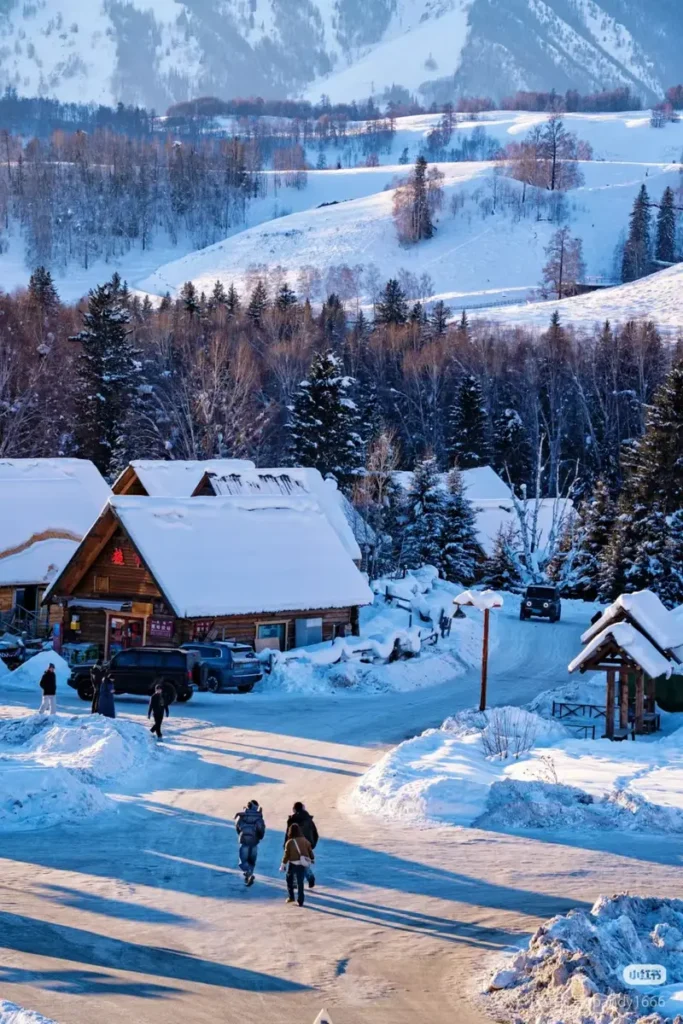
The wooden houses scattered across the village stand neatly in the snow, their rooftops covered with soft white layers that glow gently under the morning light. Along the winding paths of the village, small groups of travelers walk slowly, their long shadows stretching across the snow-covered ground. In the distance, the mountains rise in layers, dressed in silver frost. Together with the nearby forests and snowy plains, they form a peaceful winter panorama that has become one of the most iconic scenes in winter China tourism.
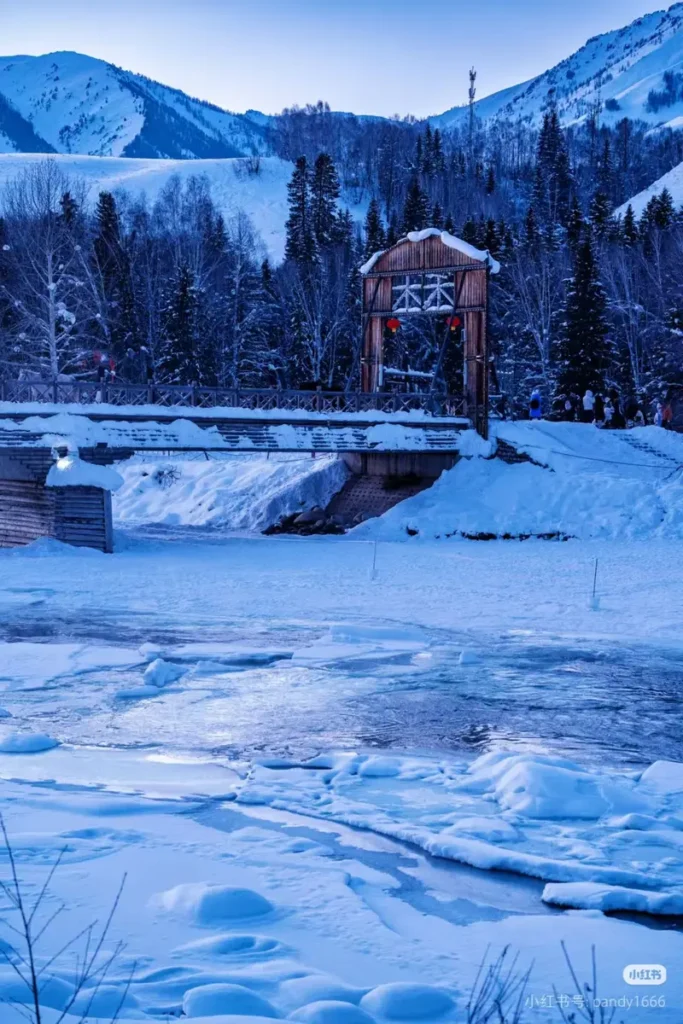
At dusk, Hemu Bridge becomes even more striking against the icy landscape. The wooden bridge, covered with thick snow, carries an atmosphere of age and quiet strength. Red lanterns hang beneath the bridge corridor, glowing warmly against the cold tones of the evening sky. Beneath the bridge, the river has not completely frozen. Pieces of drifting ice mingle with flowing water, reflecting a faint blue shimmer under the moonlight. At the far end of the bridge, silhouettes of people move about, bringing a hint of warmth and life to this peaceful corner of China tourism.
As night falls, the wooden cabins of Hemu Village gradually light up with warm yellow lamps, resembling scattered stars across the snowy fields. A traveler stands on a snowy slope, raising a small light that echoes the glow of the village below. Under the deep blue night sky, the snow-covered rooftops and distant mountain ridges appear sharply outlined. The quiet atmosphere creates a dreamlike scene, making this village one of the most magical winter landscapes in China tourism photography.
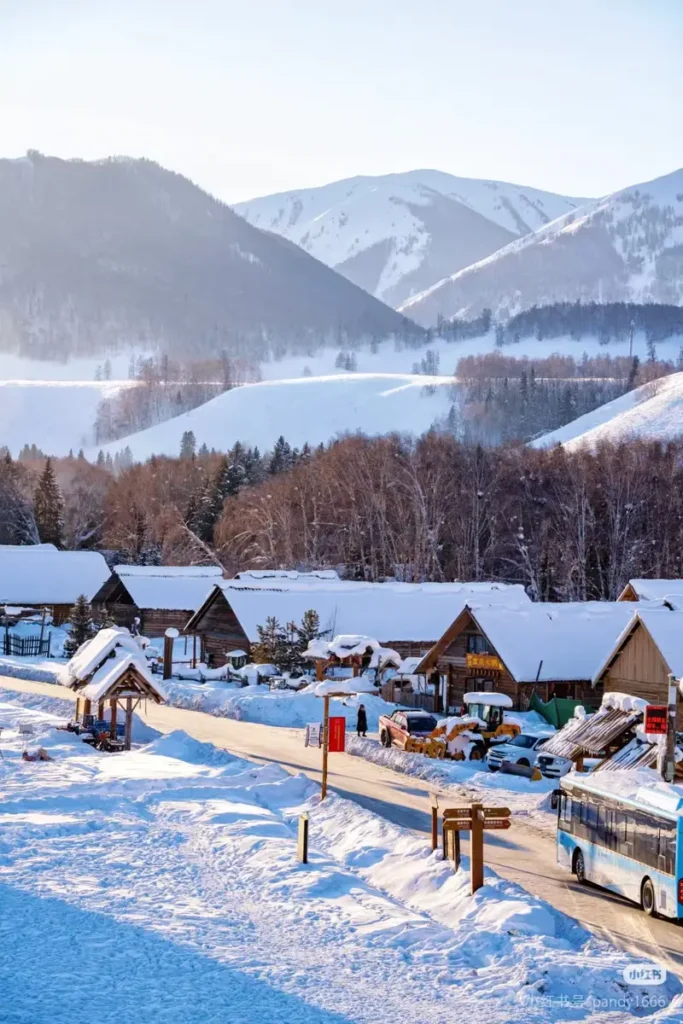
Morning in Hemu Village begins slowly. Gentle sunlight brushes across the snow, awakening the village from its long winter night. The wooden houses stand in orderly rows, their roofs sparkling under the early light. On the village road, people and vehicles begin to move again. The rumble of snow-clearing machines breaks the stillness of dawn. In the distance, mountains appear faintly through a thin mist, while nearby birch trees and pine forests create a layered winter landscape full of natural vitality.
Located in Altay Prefecture, Hemu Village lies within the famous Kanas Scenic Area, surrounded by the middle section of the Altai Mountains. The village sits in a basin formed by the meeting of the Kanas River and the Hemu River, at elevations ranging roughly from 1,100 to 2,300 meters above sea level.
The climate belongs to a cold temperate alpine zone, with an annual average temperature between −4°C and 9°C. Winter can last up to seven months, and snowfall is extremely heavy, sometimes reaching depths of three to five meters. These natural conditions make the village one of the most distinctive winter landscapes in China tourism destinations.
Hemu Village is also known as one of the best-preserved settlements of the Tuva people in China. With its wooden houses, snowy forests, and traditional lifestyle, the village has become an important cultural highlight in China tourism, attracting visitors who wish to explore both natural beauty and ethnic heritage.
Today, landmarks such as Hemu Bridge and the nearby Jikepulin International Ski Resort continue to draw travelers from across the world. In winter especially, the village feels like a living painting—where snow-covered forests, glowing cabins, and quiet mountain valleys come together to create one of the most unforgettable experiences in China tourism.

