Among the world’s great natural wonders, glaciers stand out for their sheer scale and quiet power. In Europe, none rival Iceland’s Vatnajökull ice cap. Spanning more than 3,000 square miles and covering roughly eight percent of Iceland’s landmass, it is not only the country’s largest glacier but also the largest in Europe. Scientists estimate that if its ice were evenly spread across the entire island, it would form a layer nearly 100 feet thick.
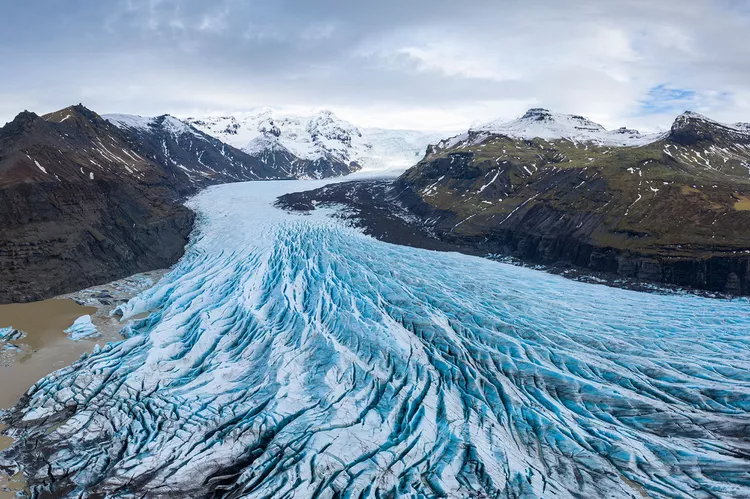
What sets Vatnajökull apart, however, is not size alone. Beneath its smooth, reflective surface lie at least seven volcanoes, most of them active, along with caldera lakes and zones of intense geothermal activity. This dramatic coexistence of ice and volcanic heat has shaped a landscape unlike anywhere else, forged over thousands of years through constant geological tension.
Recognized globally for its significance, Vatnajökull National Park was inscribed as a UNESCO World Heritage Site in 2019 and later identified by the International Geological Union as one of the most important geological areas on Earth. Covering more than 5,000 square miles, the park’s scale can be difficult to grasp, but its impact becomes immediately clear once visitors experience it in person.
One of the main gateways to the park is the Skaftafellsstofa Visitor Centre in Skaftafell, located about a four-hour drive from Reykjavík and open year-round. From here, travelers can access Skaftafellsjökull, an outlet glacier of the larger Vatnajökull ice cap. Winter is considered the ideal season to visit, as the glacier extends to lower elevations and takes on an intense blue hue, with hiking routes that can be completed in a few hours.
Beyond the glacier itself, the surrounding region offers some of Iceland’s most iconic scenery. Along the coastal edge of the ice field lies Jökulsárlón, a glacial lagoon positioned between the ice cap and the Atlantic Ocean. Its vivid blue waters are dotted with drifting icebergs, making it one of the country’s most photographed destinations. Just across the road is Diamond Beach, where fragments of ice wash ashore on black volcanic sand, sparkling like gemstones in the light.
Many travelers choose to see Vatnajökull, Jökulsárlón, and Diamond Beach in a single day trip from Reykjavík. For those seeking a more immersive journey, Iceland’s Ring Road—also known as Route 1—offers a longer expedition around the island, connecting glaciers, volcanoes, lagoons, and dramatic coastal landscapes into one continuous exploration of nature at its most powerful.

