Among recent period dramas, Sun Qian and Chen Feiyu’s “Love in the Age of Innocence” has steadily built a strong following. Set in the late 1970s, the series is adapted from the novel “Pragmatic Love” and follows the story of Fei Ni, a factory worker at Jiang Mian No. 1 Textile Mill, and Fang Muyang, a young man injured while saving others. Pressured by housing shortages and life realities of the era, the two enter a marriage of convenience in order to secure living arrangements, only to gradually develop sincere feelings as they navigate daily life together.


Rather than rushing into married life, “Love in the Age of Innocence” takes time to build emotional foundations. Fei Ni volunteers to care for the injured Fang Muyang in hopes of earning an opportunity to attend university. Their contrasting personalities—her optimism and practicality against his seemingly naïve yet quietly sharp demeanor—create moments of humor and warmth. Small details, such as improvising “red wine” from everyday ingredients or drinking coffee from enamel cups, add texture and nostalgia, grounding the romance in a vividly recreated era.

The dynamic between Fei Ni and Fang Muyang evolves naturally. Though framed as a “marriage first, love later” arrangement, their bond carries the familiarity of childhood companionship and the intimacy forged through hospital bedside conversations. In one particularly moving scene, Fei Ni delivers a tearful monologue beside Fang Muyang’s hospital bed. Sun Qian portrays the character’s suppressed frustration, unrealized dreams, and quiet resilience with restraint, culminating in a heartfelt moment when Fang Muyang awakens. Meanwhile, subtle glances exchanged by Chen Feiyu’s Fang Muyang convey unspoken affection, reinforcing the drama’s understated tone.
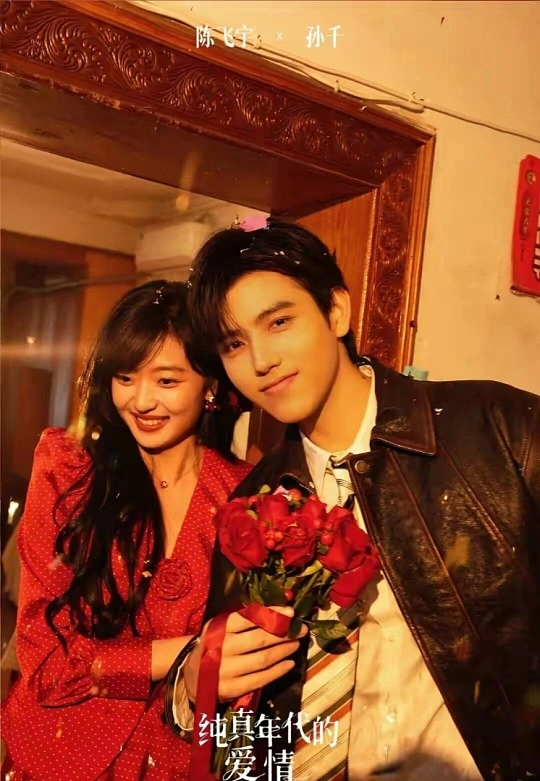
A standout sequence unfolds in a rapeseed flower field, where confession and commitment emerge beneath golden light and gentle music. Contrary to expectations, it is Fei Ni who first proposes marriage, underscoring her clarity and courage. The series presents a romance that is sweet without excess, built not on fleeting attraction but on mutual respect and shared endurance.
The supporting arcs add further dimension. Fang Mujing and Qu Hua’s relationship, portrayed by Guo Xiaoting and Wang Tianchen, explores tensions between calculation and sincerity in a changing society. Their journey from misunderstanding to mutual growth introduces a more pragmatic perspective on marriage, contrasting with the purity of the main couple. Other characters illustrate how unions formed solely for advantage may achieve stability but lack emotional depth.
Through “Love in the Age of Innocence,” Sun Qian and Chen Feiyu anchor a narrative that examines how love can emerge from practicality. Beginning with necessity and evolving into genuine devotion, the series reflects the aspirations and quiet steadfastness of ordinary people in a materially constrained era. By blending nostalgia with emotional nuance, “Love in the Age of Innocence” presents a romance that feels rooted in its time yet resonant beyond it.

