When The Epoch of Miyu (蜜语纪) premiered on April 13, 2026, it entered the urban drama landscape with a clear creative direction: a realist story centered on workplace dynamics and emotional growth, set within the structured world of high-end hotels. The series focuses on service professionals navigating hierarchy, interpersonal rules, and the tension between rational decisions and personal emotions.
The drama itself is not built on exaggerated twists. Instead, it relies on detailed observation—of how systems operate, how relationships shift under pressure, and how individuals balance control with vulnerability. Yet despite this grounded approach, one element quickly drew intense public attention: the casting of Zhu Zhu, and the perceived contrast between her real-life background and the role she takes on.
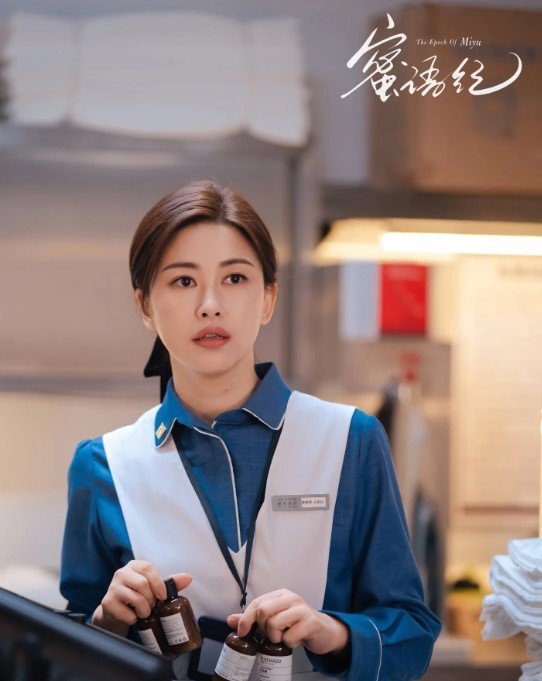
A Drama Defined by Industry Detail and Emotional Complexity
At its core, The Epoch of Miyu (蜜语纪) stands out for two main reasons. First, it brings a relatively fresh industry setting—the luxury hospitality sector—into focus. The series does not treat this environment as mere backdrop, but actively incorporates operational details such as service protocols, client interaction, and internal hierarchy, giving the story a sense of realism.
Second, the drama builds its narrative through complex character relationships. Rather than presenting simplified personalities, it emphasizes emotional layers. Characters are often placed in situations where they must choose between professional logic and personal feeling, creating a continuous sense of internal tension.
This combination of industry realism and emotional nuance allows The Epoch of Miyu (蜜语纪) to move beyond formula, offering both the softness of an emotional drama and the structural tension of a workplace series.
Zhu Zhu’s Role: Control, Distance, and Gradual Vulnerability
Within this framework, Zhu Zhu portrays a mature, rational, and highly self-controlled woman—typically positioned within key roles in the workplace system. She is not written as a traditionally “gentle” character, but rather as someone defined by composure, clarity, and a certain emotional distance.
In professional settings, her strengths are evident. She demonstrates sharp judgment, strong execution, and the ability to remain calm in complex situations. This positions her as a figure of authority within the narrative, someone who understands both the visible and invisible rules of the environment.
However, the character is not static. As the story progresses, emotional layers begin to emerge. Beneath the controlled exterior lies a more conflicted inner world—moments of hesitation, vulnerability, and personal struggle gradually surface. This shift adds depth, transforming her from a purely “strong” figure into a more complete and human character.
This duality—external precision and internal complexity—is central to the role, and it aligns closely with Zhu Zhu’s established acting style.

Why Zhu Zhu’s Screen Presence Fits the Character
Zhu Zhu has long been recognized for a performance style built on restraint. Rather than relying on overt emotional display, she conveys meaning through subtle details—eye movement, tone, and controlled pacing. This makes her particularly effective in roles that require emotional containment.
Her natural sense of composure and refinement complements characters who operate within structured, high-pressure environments. In The Epoch of Miyu (蜜语纪), this quality enhances the credibility of a character who must maintain control while navigating complex workplace dynamics.
At the same time, her ability to gradually reveal emotional depth allows the character to evolve in a believable way. Instead of abrupt transformation, the audience witnesses a slow unveiling of internal conflict, which strengthens the drama’s realist tone.
Her Background: A Context That Shapes Audience Perception
The discussion surrounding The Epoch of Miyu (蜜语纪) cannot be separated from Zhu Zhu’s personal background, which has long been part of her public image.
Born in Beijing in 1984, Zhu Zhu grew up in a family with a strong cultural and educational foundation. Her grandfather, Zhu Xuzhi, was a founding major general, while her father, Zhu Hanbin, is an entrepreneur. Her mother worked at the National Library, contributing to an environment that emphasized both discipline and intellectual development.
From a young age, she studied piano and developed strong language skills, gaining early exposure to international culture. This background provided her with a broad perspective and laid the foundation for her later career across different markets.
Her professional journey reflects this trajectory. In 2005, she won the Beijing division of MTV’s VJ competition and became a host on MTV’s global platform, entering the public eye through an international media environment. She later released a music album before transitioning into acting.
Subsequently, Zhu Zhu signed with Creative Artists Agency (CAA) and participated in international productions such as Cloud Atlas, The Man with the Iron Fists, and Marco Polo, gradually building recognition beyond China. Her appearance at the Met Gala further highlighted her presence within global cultural and fashion circles.
After returning her focus to the domestic market, she continued to develop her acting career, appearing in series such as The Justice, The Rebel, Qin Empire Epic, and The Right Way to Open Life. Her performance in The Justice earned her the Best Supporting Actress award at the 7th Wenrong Awards, marking industry recognition of her acting ability.
In recent years, she has remained active, with projects including The Tale of Rose, Su Di, and new productions continuing into 2025 and 2026. The Epoch of Miyu (蜜语纪) represents a continuation of her presence in urban dramas, particularly in roles centered on mature, composed female characters.
The Source of Debate: Contrast Rather Than Contradiction
The audience reaction to Zhu Zhu’s role largely comes from a perceived contrast between her refined public image and the grounded nature of certain aspects of the character, including her position within the service system at specific points in the narrative.
However, this contrast does not necessarily indicate a mismatch. Instead, it highlights a tension that can be narratively meaningful. In a drama that focuses on hierarchy and identity, the relationship between external roles and internal complexity becomes a key theme.
Rather than defining the character solely by her position, The Epoch of Miyu (蜜语纪) appears to use this contrast to explore how individuals navigate different layers of identity within structured environments.
A Broader Shift in Character Representation
More broadly, The Epoch of Miyu reflects an ongoing shift in urban dramas toward more nuanced character construction. Female characters are no longer confined to single archetypes. Instead, they are allowed to exist with contradictions—strong yet vulnerable, controlled yet emotionally complex.
Zhu Zhu’s role fits within this direction. It moves beyond surface-level identity and focuses on internal development, aligning with audience expectations for more realistic and layered storytelling.
Between Expectation and Interpretation
The discussion surrounding The Epoch of Miyu ultimately reveals how strongly audience perception is shaped by an actor’s established image. Zhu Zhu’s background and career have created a recognizable presence, one that naturally influences how viewers approach her roles.
Yet it is precisely this familiarity that allows the drama to introduce contrast. By placing her within a character that unfolds gradually, the series invites viewers to move beyond initial impressions and engage more deeply with the narrative.
If the story continues to develop its characters with the same level of detail and restraint, the initial debate may shift toward a more balanced understanding—where the focus is no longer on whether the casting feels unexpected, but on how effectively it contributes to the story being told.

