At 51, Peter Ho seemed to be living a relatively low-key life—working out at home, playing video games, and quietly preparing for his next directing project. Yet within the span of a single month, he unexpectedly found himself at the center of a viral resurgence, receiving collaboration offers from three of China’s biggest internet giants: Alibaba, Tencent, and JD.com.
The catalyst behind this sudden wave of attention traces back not to a new release, but to a role he played 14 years ago—Xiang Yu in King’s War (楚汉传奇).
A Viral Contrast Sparks Rediscovery
The turning point came in early March, when the costume drama Zhu Yu (逐玉) began airing. Lead actor Zhang Linghe’s portrayal of General Wu’an Hou drew criticism from viewers, particularly for his overly polished appearance—fair skin, pristine armor, and a stylized look that many felt lacked realism. Online, the character was mockingly labeled the “foundation makeup general.”
Dissatisfied with this aesthetic, audiences began searching for examples of what a “real general” should look like. It was during this wave of comparison that Peter Ho’s performance in King’s War resurfaced.
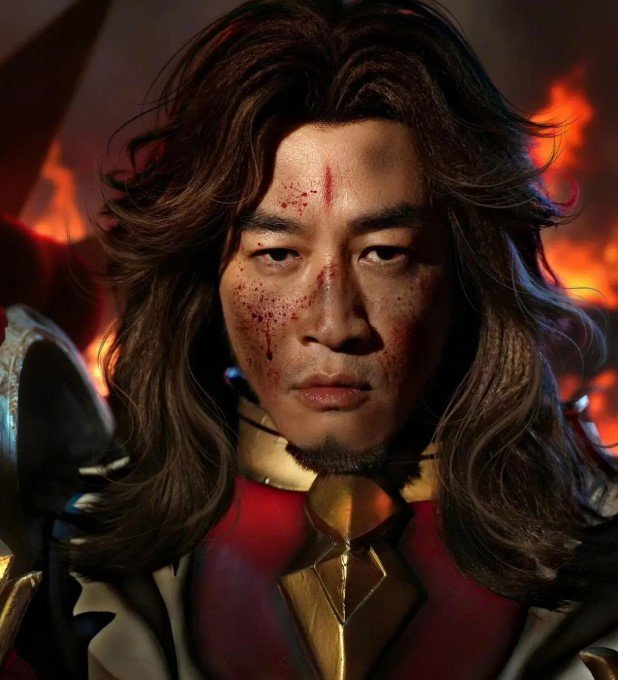
Clips of his portrayal quickly spread across social media. Covered in mud and blood, with a gaze filled with intensity and brutality, his version of Xiang Yu felt raw and grounded. Standing at 186 cm with a muscular build of 95 kilograms, Peter Ho exuded a physical presence that translated powerfully even through the screen.
Data-Driven Popularity Surge
The response was immediate and measurable. According to third-party platform data, Peter Ho’s Douyin account gained over 12 million new likes within 30 days, along with 1.76 million new followers. Meanwhile, user-generated content related to his Xiang Yu amassed more than 1.2 billion views.
The resurgence even sparked humorous commentary online. Some joked that when asked which drama made him popular, Peter Ho should answer Zhu Yu—despite not appearing in it at all.
From Internet Buzz to Real-World Invitations
The viral momentum soon crossed into offline impact. In early April, netizens in Suqian, Jiangsu—historically known as the hometown of Xiang Yu—suggested inviting Peter Ho to appear at the opening ceremony of the Suqian Super League. Their idea: have him ride in wearing armor and shout “kill” three times in character.
Suqian’s official tourism account responded the same day with the phrase “Awaiting the return of the Overlord.” Within a week, a formal invitation was issued. On April 13, it was officially announced that Peter Ho would appear at the Suqian Olympic Sports Center on April 18 to support the local team in a match against Nanjing.
JD.com, whose founder Liu Qiangdong is also from Suqian, moved quickly to capitalize on the moment. The company collaborated with local tourism authorities and Peter Ho’s team to locate the original costume designers from King’s War and recreate Xiang Yu’s iconic armor.
The replicated armor weighs around 50 jin (approximately 25 kilograms), with the upper body retaining its metallic texture for authenticity, while the lower portion uses lighter materials for mobility. The inner layers were also upgraded with more refined fabrics compared to the original.
A Full-Scale Commercial Response
The event quickly evolved into a multi-platform marketing wave. From April 18, Suqian announced that all state-owned scenic spots would offer free entry for ten consecutive days. Visitors with match tickets could also enjoy discounts at hotels and restaurants across the city.
Tencent’s mobile game Honor of Kings was among the first major brands to react. On April 15, it released a promotional video featuring Peter Ho cosplaying Xiang Yu’s in-game skin “True Overlord.” The video blended humor—such as joking about being “physically weak”—with a recreation of the iconic “lifting the cauldron” moment, reinforcing the connection between the historical figure and his modern digital counterpart.
JD.com followed with its own campaign, launching a series of promotions tied to the Suqian event. Users searching “Watch Suqian Super League” on the JD app could access various benefits, including limited-time offers, food delivery coupons, and prize-sharing activities totaling tens of millions in platform credits.
Meanwhile, with the Suqian team facing Nanjing—sponsored by Alipay—reports indicated that Alipay was also preparing its own collaboration. Plans included inviting Peter Ho to participate in promotional events, further intensifying the competitive marketing atmosphere.
Choosing Direction Over Hype
Amid this surge of attention and commercial offers, Peter Ho remains focused on a different priority. Currently in Taipei, he is preparing his new directorial project, Dui Ni Xin Dong De Yu Yan (对你心动的预言). On April 15, he attended a press conference for the project, where he addressed the unexpected wave of opportunities.
While acknowledging the influx of offers, he described life as a series of choices. For now, he has chosen to prioritize his work as a director, declining most invitations that fall outside this path.
Reflecting on his journey, Peter Ho shared a personal anecdote: when he once worked at a restaurant in his youth, customers would call him “trash boy.” He understood that it was not his name. In the same way, while he appreciates the renewed admiration for Xiang Yu, he hopes that audiences will ultimately remember him as “Director Peter Ho.”
A Delayed Return on Dedication
Looking back, the resurgence feels almost like a delayed reward. During the filming of King’s War in 2012, Peter Ho spent seven months training intensively to prepare for the role, building his physique from scratch to 95 kilograms. He practiced weapon movements daily with 10-kilogram sandbags, repeating motions thousands of times, and insisted on performing without a stunt double—even in freezing conditions.
Years later, during the filming of Zheng Tu (征途) in 2020, he suffered a comminuted fracture in his right hand but continued shooting action scenes after receiving injections. Three steel pins remain in his body to this day.
The physical toll, discipline, and commitment he invested in his craft did not fade with time. Instead, more than a decade later, they have resurfaced in an unexpected way—amplified by the internet and reinterpreted by a new generation of viewers.
For Peter Ho, this moment is not just a resurgence of popularity, but a reminder that effort, even when temporarily overlooked, can find its way back into the spotlight.

