On February 5, the honors of the 2025 Weibo Night were officially announced. Xiao Zhan was named Weibo KING, Yang Mi received the title of Weibo QUEEN, while director Zhang Yimou was awarded the “Weibo International Influence Director” honor.
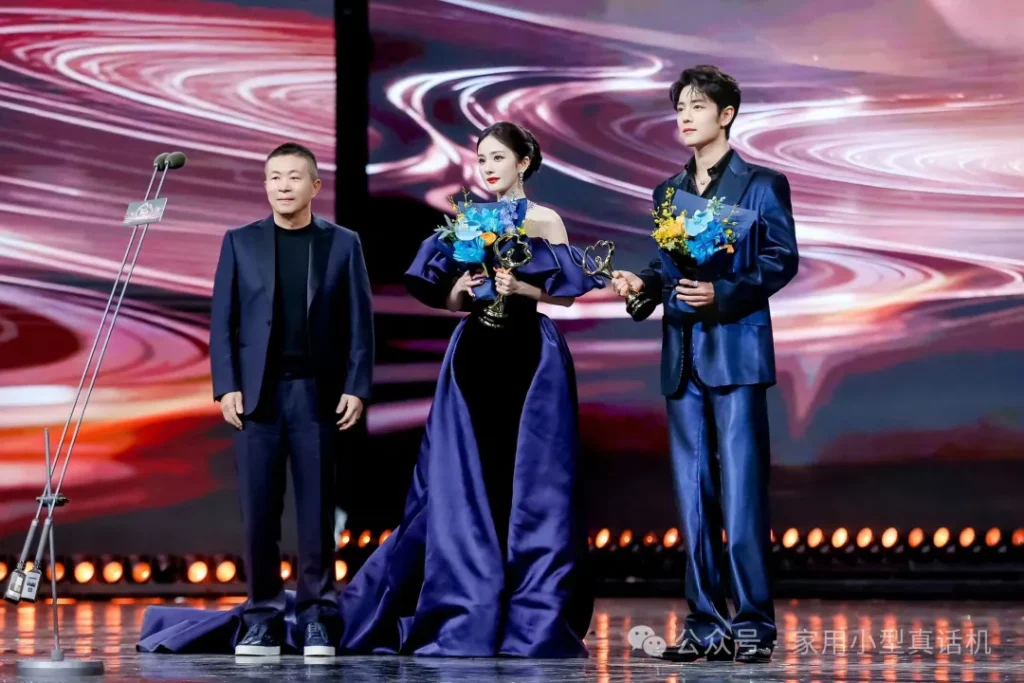
Beyond the glamorous moments—such as Zhang Yifan’s striking gown and headpiece, or the eye-catching on-screen pairings of Chen Duling–Chen Zheyuan and Zhang Linghe–Bai Lu—the real discussion of the night inevitably centered on the so-called “C-position controversy” involving Xin Zhilei, Yang Mi, and Xiao Zhan.

At its core, the incident was a fairly old-fashioned event execution error. Yet it escalated far beyond its actual weight because many online discussions chose to frame it through a fan-circle power struggle narrative, rather than a straightforward production mistake.
One of the most widely circulated claims was also the most far-fetched: that empty seats in the second and third rows existed because other celebrities were “afraid to sit” before seeing where Yang Mi and Xiao Zhan would be placed.
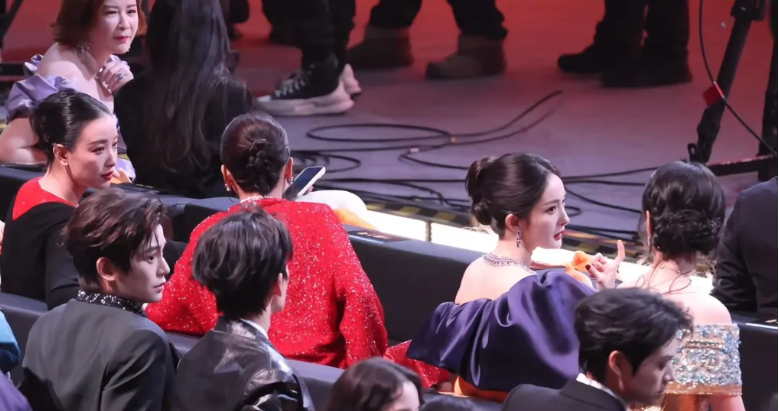
This interpretation is both inexperienced and deeply shaped by fan imagination. In reality, for events of this scale, seating arrangements are finalized well in advance. Name cards are pre-printed, positions are fixed, and artists enter strictly according to on-site instructions. The appearance of empty seats clearly pointed to a delayed or mismanaged entry process, with artists waiting backstage or at the side stage.
If celebrities truly had to watch each other’s reactions before daring to sit down, Weibo Night would hardly qualify as a top-tier industry event. This is a platform-driven, commercially oriented ceremony where process always outweighs personal dynamics.
The real trigger of the controversy was the movement of Xiao Zhan’s nameplate.
According to the organizer’s later apology, the original arrangement was stable and reasonable: Xin Zhilei, a Venice Best Actress winner, was seated in the center, flanked by Xiao Zhan and Yang Mi on either side. From a professional standpoint, this setup respected both award credibility and star presence.
However, staff members altered the arrangement on-site by removing Xiao Zhan’s nameplate in an attempt to create a “dual C-position” featuring Xin Zhilei and Yang Mi. This adjustment displaced Xiao Zhan to another area alongside Ni Ni, which in turn disrupted the nameplates for two entire rows behind them.
At that point, social media and forums erupted. Discussions quickly shifted away from organizer accountability and toward accusations of “C-position competition,” particularly targeting Yang Mi. Ironically, this was when the “real” Weibo Night—online chaos—began.
Yang Mi’s studio responded swiftly and directly, publicly tagging the organizer and demanding clarification. This firm stance was less about confrontation and more about drawing a clear boundary: the organizer’s mistake should not be transferred onto the artist.
On the other side, Xiao Zhan’s team chose silence.
Objectively, this silence did not protect the artist. Instead, it handed emotional control entirely over to fan communities. As a result, public anger that should have been directed at the organizers was redirected toward female artists, turning a procedural failure into a fabricated narrative of “female celebrity rivalry.”
It is understandable that Xiao Zhan’s fans felt wronged—losing a planned second-row center seat would frustrate anyone. The issue lies in how some fans chose to respond: mass attacks on female celebrities in an attempt to reframe an organizational error as a palace-style power struggle.
Placed back into the real industry context, this narrative simply does not hold up.
In terms of seniority, platform relationships, commercial value, and public recognition, Yang Mi neither needed nor benefited from such maneuvering. A direct confrontation between Xiao Zhan and Yang Mi, at least at this stage, is not an even matchup.
When male idol fandoms operate under the assumption that “the entire world is out to get my favorite,” the result is not sympathy but fatigue—from both the public and the industry. It also places the artist in a more passive and awkward position.
It is highly likely that Xiao Zhan himself had no intention of being dragged into these power games at all.

