In recent years, Huo Siyan has gradually stepped away from the front lines of the film and television industry. Yet her presence in the public sphere has not diminished; instead, it has taken on a different form—one that is more closely tied to everyday life and personal pursuits. In April 2026, she appeared at the “Princess Cup” International Dog Show in Thailand, not as a celebrity guest, but as a competing handler. Accompanied by her 11-month-old standard poodle “Huo Mila,” she achieved notable results in the Puppy category, securing three Best in Show championships and two runner-up placements, along with multiple wins in group competitions against strong contenders.
What drew particular attention was not simply the outcome, but the manner in which it was achieved. Huo Siyan did not participate as a symbolic figure; she was fully involved in every aspect of the process, from training to presentation. Her control over the dog’s gait, timing, and ring performance reflected clear signs of systematic preparation. Judges reportedly recognized this level of execution, allowing her performance to be evaluated within a professional framework rather than as a novelty appearance. As a result, the discussion surrounding her participation quickly moved beyond celebrity curiosity and into a broader conversation about dedication and skill.
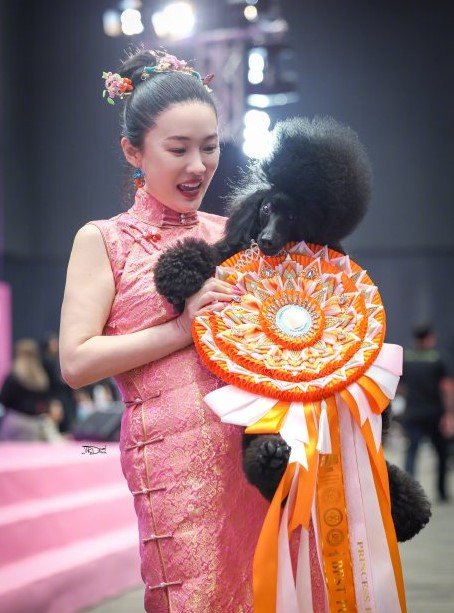
At the same time, images of Huo Siyan attending the event alongside her husband Du Jiang and their son “Hmm” circulated widely online. Unlike traditional public appearances that emphasize stylized presentation, she appeared in a more natural state, wearing a qipao with minimal styling. This visual contrast shifted the focus of public discourse. The conversation extended beyond competition results to include reflections on authenticity, aging, and the aesthetics of a less curated public image. In this sense, her appearance functioned as both a professional statement and a subtle commentary on changing expectations of celebrity presence.
Seen in a longer timeline, this achievement is not an isolated event but the result of sustained involvement. Over the past few years, Huo Siyan has repeatedly participated in dog shows in Europe and Asia, gradually building experience within the field. She has also pursued formal qualifications related to canine training and handling, transforming what may have begun as a personal interest into a structured, skill-based endeavor. Her decision to adopt laboratory dogs, including one named “Zhenzhu,” has further contributed to shaping her public identity, adding a dimension of social responsibility to her evolving image.
This shift becomes more meaningful when contrasted with her earlier career. Huo Siyan was once widely recognized for her roles in period dramas, particularly her portrayal of “Zi’er” in the classic fantasy series Seven Fairies (欢天喜地七仙女). That role, defined by a gentle and expressive presence, left a lasting impression on audiences and established her as a recognizable figure within a specific archetype of costume drama heroines. In subsequent projects, she continued to develop this image, gradually transitioning from youthful roles to more mature characters while maintaining a consistent screen identity.
However, rather than continuing along a conventional trajectory within the industry, Huo Siyan appears to have made a deliberate adjustment. Her reduced output in film and television does not indicate withdrawal, but rather a redistribution of focus. By channeling her time and energy into personal interests—particularly those that can be developed into areas of expertise—she has redefined how she remains visible to the public. In this process, her identity has shifted from being primarily role-based to being rooted in lived experience.
The Thailand dog show, in this context, serves as a visible milestone within that broader transition. It demonstrates not only her commitment to a new field, but also her ability to translate personal passion into recognized achievement. More importantly, it invites a reconsideration of what it means for an actress to “step back” from the spotlight. In Huo Siyan’s case, stepping back from one form of visibility has enabled her to construct another—one that is less dependent on scripted narratives and more aligned with personal agency.
Ultimately, her journey reflects a form of continuity rather than departure. The shift from portraying characters on screen to engaging in real-world pursuits does not represent a break, but a reconfiguration of priorities. Through this transition, Huo Siyan has not disappeared from public view; she has simply chosen a different way of being seen—one defined less by performance, and more by intention.

