The large-scale historical drama Northern Wei Dynasty has officially announced its lead cast, confirming Yang Mi as the central female protagonist and Liu Xueyi as the male lead. Adapted as a major “female-led” project, the series immediately drew attention—not only for its scale and theme, but also for the casting decisions behind it, which have already sparked discussion across industry circles and fan communities.
Positioned as a flagship historical production, Northern Wei Dynasty is built around a strong female narrative core. Projects of this type typically emphasize the rise, strategy, and influence of a single heroine within a broader political landscape. For Yang Mi, whose career has long been associated with commercially successful costume dramas, this role represents both continuity and recalibration. While she remains a major name in the genre, the current market environment—shaped by newer actors and shifting audience expectations—places greater importance on project selection and narrative positioning.
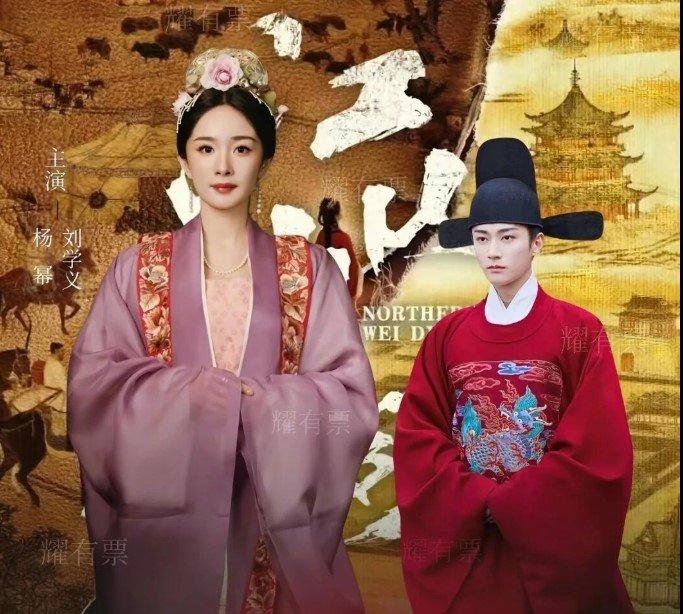
The confirmation of Liu Xueyi as the male lead is where much of the early conversation has concentrated. Prior to the official announcement, there had been visible fluctuations in casting discussions, including speculation involving Deng Wei. Reports suggested competing interests during the selection process, but the final decision ultimately settled on Liu Xueyi, a choice that reflects not only casting preference but also structural considerations within the project.
In female-driven dramas like Northern Wei Dynasty, the balance between leads is inherently asymmetrical. The narrative is designed to center on the female protagonist, often leaving the male lead in a supporting or complementary position. Under such conditions, highly popular male actors may be less inclined to participate, particularly if the role does not align with their market positioning or screen presence expectations. This dynamic narrows the pool of viable candidates, making actors like Liu Xueyi—who combine recognizability with flexibility—more suitable for collaboration.
Following the announcement, some online discussions framed Liu Xueyi’s involvement as a “career upgrade,” given the opportunity to headline alongside Yang Mi. While this interpretation holds some surface-level validity, it simplifies a more complex reality. The casting can just as easily be understood as a mutually functional arrangement: a male lead willing to operate within a female-centered narrative, and a production seeking balance rather than competition.
At the same time, rumors began circulating that the male lead’s role might be expanded, leading to dissatisfaction among segments of Yang Mi’s fanbase. Concerns over potential “added scenes” reflect a broader sensitivity within the genre, where the integrity of a “big female lead” framework is closely guarded by audiences. However, there is currently no confirmed evidence suggesting significant script alterations. In practical terms, actors at Liu Xueyi’s level typically do not possess the authority to reshape narrative structure in a production of this scale. Creative direction remains largely in the hands of producers and writers.
From an industry standpoint, this situation highlights a recurring pattern. Casting decisions in major dramas are rarely based solely on performance considerations; they are shaped by a combination of market logic, narrative design, and audience expectation. In the case of Northern Wei Dynasty, the choice of Liu Xueyi reflects an attempt to maintain equilibrium—ensuring that the focus remains on the central character while still providing a credible and engaging counterpart.
Ultimately, the early controversy surrounding Northern Wei Dynasty reveals more about the current ecosystem of Chinese costume dramas than about any individual actor. It underscores the challenges of balancing star power with narrative intent, particularly in projects that are explicitly designed to foreground one lead.
As the drama moves forward, the key factor will not be pre-release debate, but execution. Whether Yang Mi can deliver a compelling central performance, and whether Liu Xueyi can effectively support that arc without disrupting its balance, will determine how the series is ultimately received. In a market where expectations are high and competition is intense, Northern Wei Dynasty enters not just as another historical drama, but as a test of how well the “female-led epic” formula can still resonate with contemporary audiences.

