A Nine-Year Promise Finally Returns
On April 8, 2026, Rebirth: Ice Lake (冰湖重生) officially premiered, attempting to continue the story left unresolved at the end of Princess Agents. For nearly a decade, audiences had held onto the lingering question of Yu Wen Yue’s fate after the iconic “Ice Lake” scene, a moment that became one of the most discussed open endings in Chinese drama history. The sequel, positioned as a direct continuation, arrives with both narrative responsibility and emotional expectation—two elements that are not easily balanced.
Starring Li Yunrui, Huangyang Tiantian, and Zhang Kangle, the series picks up from that frozen moment in time, expanding the story into a broader arc of revenge, rediscovery, and political conflict. On paper, the premise carries strong appeal: a beloved IP, a long-awaited continuation, and a built-in audience base shaped by years of anticipation. Yet from the moment of its release, the drama reveals a more complicated reality—one where expectation and execution do not fully align.

From Child Role to Lead: A Difficult Transition
At the center of the discussion is Huangyang Tiantian, who now takes on the role of Chu Qiao. Her casting carries a symbolic continuity—having previously portrayed the younger version of the character in Princess Agents, she now steps into the adult narrative. This transition, however, is not merely a matter of time passing; it demands a transformation in presence, authority, and emotional weight.
Chu Qiao is not a character defined by innocence or growth alone, but by survival, battle, and psychological endurance. To embody such a figure requires not only technical performance, but also a convincing sense of lived experience. For many viewers, this remains the core challenge of the current portrayal. The gap between the character’s history and her on-screen presence creates a subtle dissonance—one that cannot be resolved by narrative explanation alone.
This tension becomes even more visible under the shadow of Zhao Liying’s original performance. Her version of Chu Qiao established a benchmark defined by intensity, resilience, and emotional complexity. As a result, any reinterpretation inevitably invites comparison, placing additional pressure on the new portrayal to justify its existence.
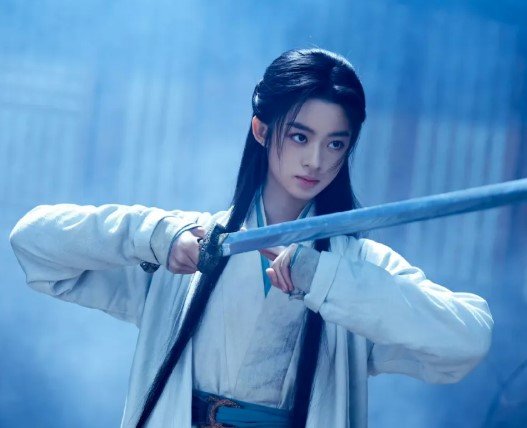
A Thoughtful Reflection Meets a Complicated Context
On the day of the premiere, Huangyang Tiantian shared a reflective essay discussing the three forms of strength she associates with Chu Qiao: resilience, courage, and solitude. Her interpretation leans toward an internal reading of the character—emphasizing endurance over spectacle, and emotional continuity over dramatic display.
She describes resilience as a sustaining force, courage as the acceptance of uncertainty, and solitude as an intrinsic condition of growth. Drawing from her filming experience at an actual ice lake, she frames the character through a visual metaphor: beneath a calm, frozen surface lies a constantly moving current. It is an image that aligns closely with her acting approach—controlled on the outside, active within.
Yet the reception of this reflection reveals a broader issue. Rather than engaging solely with the content of her writing, public discussion quickly shifted toward surrounding controversies and pre-existing perceptions. In doing so, the essay became less a statement about the character, and more a focal point for ongoing discourse about the actress herself.
This dynamic reflects a common pattern in contemporary media environments, where meaning is often shaped less by what is said, and more by the context in which it is received.

A Cold Market Response
Beyond online discussion, the drama’s commercial performance adds another layer to its reception. Despite its positioning as a high-budget production, Rebirth: Ice Lake (冰湖重生) launched without advertising placements—a rare and notable situation for a project of this scale. Early platform metrics also indicate a relatively modest start compared to similar productions.
Such indicators suggest a cautious stance from both the market and the audience. While the IP carries historical weight, that weight does not automatically translate into present-day confidence. In an industry increasingly driven by risk assessment, factors such as casting controversy, tonal uncertainty, and pre-release discussion can significantly influence investment decisions.
The result is a form of “cold start”—not defined by immediate rejection, but by hesitation. The audience is present, but not fully committed; the market is aware, but not fully convinced.
Between Continuation and Comparison
One of the central challenges facing Rebirth: Ice Lake (冰湖重生) lies in its dual identity. It is both a continuation and a reinterpretation, a sequel that must remain connected to its origin while also establishing its own narrative voice. This balance is difficult to achieve, particularly when the original work has achieved a lasting cultural imprint.
The more recognizable the original, the stronger the comparison. Each scene, each character decision, and each tonal shift becomes part of an ongoing dialogue between past and present. In this context, the sequel is not only telling a story—it is negotiating with memory.
Interestingly, this dynamic has led to a renewed appreciation for the original cast and performances. Without direct involvement, earlier portrayals regain visibility, reinforcing the enduring impact of the initial narrative.
Rebirth Beyond the Screen
The theme of “rebirth” operates on multiple levels within Rebirth: Ice Lake (冰湖重生). Within the story, it represents Chu Qiao’s journey toward reclaiming identity and purpose. Outside the narrative, it reflects the position of Huangyang Tiantian herself—a young actress navigating the transition from early recognition to leading responsibility.
This parallel adds a layer of complexity to the viewing experience. The character’s struggle for renewal mirrors the actress’s own process of repositioning within the industry. Both are situated at a point of transformation, where outcomes remain uncertain and direction is still being defined.
Conclusion: An Unfinished Outcome
Rebirth: Ice Lake (冰湖重生) begins not with resolution, but with tension—between expectation and execution, memory and reinvention, intention and reception. It is a project that carries significant weight, yet has not fully translated that weight into immediate impact.
For Huangyang Tiantian, the drama represents both an opportunity and a challenge. Her interpretation of Chu Qiao, along with the public response it generates, will continue to shape her trajectory in the industry. Whether this role becomes a turning point or a transitional step remains to be seen.
At this stage, the story—both on-screen and off—remains open. Like the frozen lake it takes its name from, what is visible is only the surface. Beneath it, movement continues, quiet but persistent, shaping what comes next.

