Premiering on May 2 as a Tencent Video exclusive, the costume short drama Love Between Two Hearts (两心不疑) puts its core hook front and center: an emperor and empress who can’t stand each other are forced to swap bodies and live each other’s lives. What begins as chaos gradually becomes comprehension.
The premise itself isn’t new. Body swaps have long been a staple of romantic storytelling. What determines whether such a story resonates, however, is not the novelty of the setup, but whether the narrative can convincingly explore what each character endures in the other’s position—and whether the humor carries emotional weight beyond surface-level amusement.
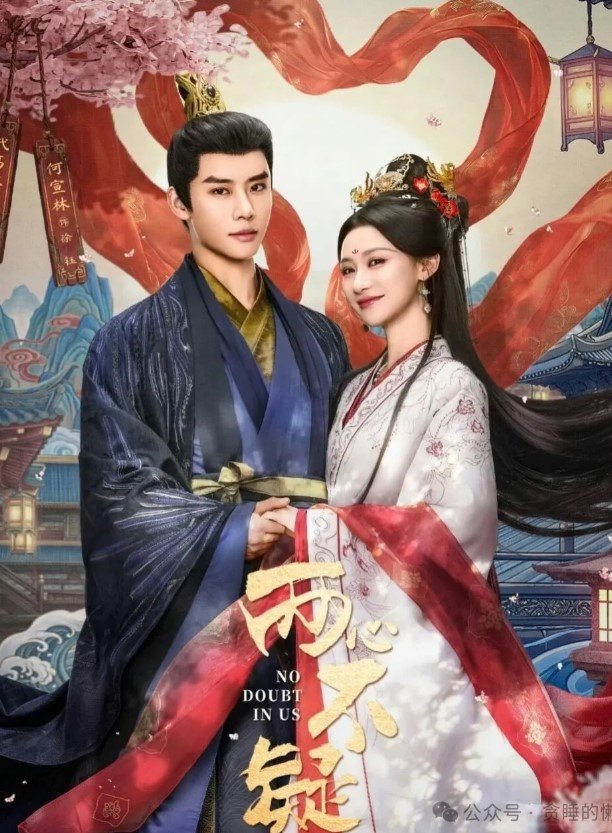
From what has been revealed so far, Love Between Two Hearts (两心不疑) follows a clear tonal structure. On the surface, it leans into light comedy and romance, but underneath, it addresses a more complex theme: the difficulty of truly understanding one’s partner. It suggests that what people perceive as familiarity is often limited to their own perspective rather than a genuine grasp of the other’s reality.
The most immediately striking layer comes from Xu Yu, played by He Xuanlin, who finds herself in the emperor’s position. Raised in a military household, she is accustomed to direct action and straightforward decision-making. Placing such a character on the throne—where diplomacy, ritual, and layered communication dominate—creates an inherent clash. The contrast generates comedic tension, as someone used to solving problems through action must now navigate a system built on words, etiquette, and political nuance.
Yet beneath the humor lies a more substantive shift. Once seated in the emperor’s role, Xu Yu begins to see the complexity behind decisions she once criticized. Governance is no longer abstract; every move is scrutinized, every choice tied to competing interests. The caution she may have once dismissed becomes understandable, even necessary. The position itself imposes a way of thinking that cannot be fully grasped from the outside.
On the other side, Xiao Jinyun, portrayed by Dai Gaozheng, faces a different kind of disorientation. As emperor, he is used to balancing power structures and controlling outcomes. As empress, he enters a space governed not by overt authority but by subtle dynamics—unspoken hierarchies, coded interactions, and constant observation. The inner court proves to be no less complex than the political arena, but its rules are less visible and more emotionally charged.

Here, the dramatic tension shifts from control to vulnerability. Xiao Jinyun must adapt not only to a different social role but also to a body and environment that restrict his usual methods. His discomfort, while often played for humor, underscores a deeper realization: the challenges Xu Yu faces are not trivial, but structurally embedded in her position.
This dual perspective is where Love Between Two Hearts (两心不疑) distinguishes itself from more conventional romantic narratives. Rather than relying on prolonged misunderstandings or exaggerated conflict, it constructs a gradual transformation in the relationship. Initial irritation gives way to confusion, then to empathy, and ultimately to trust. The emotional progression feels earned because it is grounded in lived experience—albeit within a fictional device.
In this sense, the body swap functions less as a gimmick and more as a narrative mechanism for perspective shift. The drama suggests that many relational conflicts stem not from inherent incompatibility, but from an incomplete understanding of what the other person carries. Traits perceived as flaws often have underlying reasons that remain invisible without direct experience.
This thematic approach resonates beyond the fictional setting. In contemporary life, individuals frequently interpret others through their own frameworks, even within close relationships. By forcing its characters into each other’s positions, Love Between Two Hearts (两心不疑) visualizes the concept of empathy in a literal and accessible way.
The supporting cast, including Ma Hanyi, Yu Yilei, and Li Qing’er, further enriches the interplay between court politics and inner-palace dynamics, while the overall structure leans on character interaction rather than large-scale spectacle. This aligns with the rhythm of short-form storytelling, where efficiency and clarity are essential.
Whether the drama can sustain its momentum remains an open question. Many works built on high-concept premises struggle to maintain depth beyond the initial setup. However, Love Between Two Hearts (两心不疑) appears to anchor its narrative in character evolution rather than relying solely on situational humor, which provides a more stable foundation.
Ultimately, the appeal of Love Between Two Hearts (两心不疑) lies not in the novelty of exchanging bodies, but in what that exchange reveals. The journey from mutual dissatisfaction to mutual understanding is not driven by grand events, but by a forced shift in perspective—one that allows each character to finally see the other not through assumption, but through experience.

