Upcoming costume drama Jinzhi is already attracting strong attention as one of Tencent Video’s major S+ projects, combining female rise-to-power storytelling, political intrigue, and richly detailed Song Dynasty aesthetics.
Produced jointly by Tencent Video and Hao Han Entertainment, the series stars Li Yitong and Chen Xingxu as dual leads, marking their first collaboration in nine years since appearing together in The Legend of the Condor Heroes. Back then, the two portrayed Huang Rong and Yang Kang respectively, and their reunion in a completely different historical setting has already become a major point of discussion among viewers.
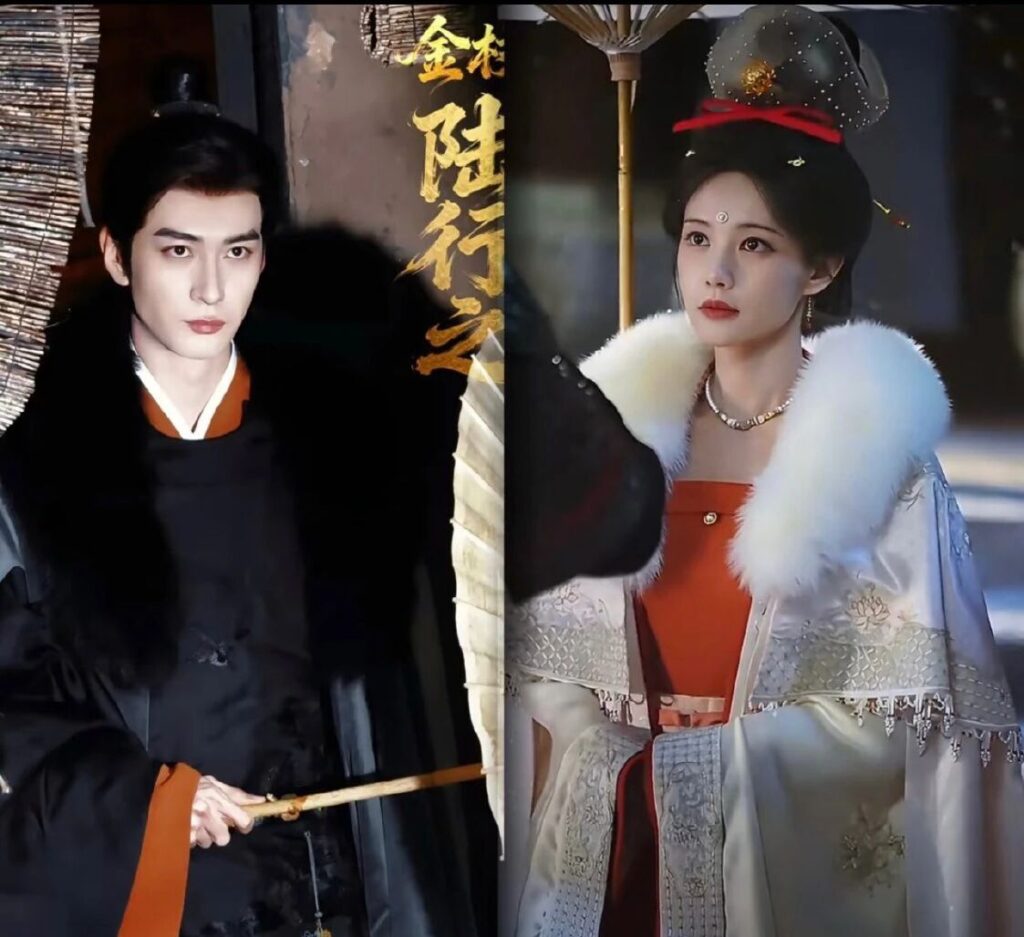
In Jinzhi, Li Yitong plays Chen Que’er, a young woman born into the low-status “jianji” class whose fate changes after a chance accident leads others to mistake her for the noble Princess Zhao Jinzhi. Thrust into the highly dangerous world of aristocratic politics inside the Rong State Duke’s household, Chen Que’er is forced to rely on intelligence, adaptability, and resilience in order to survive.
The role appears especially suited to Li Yitong’s acting style, which often balances softness with emotional sharpness. According to currently released information, the actress will also take on a dual role by portraying both the humble Chen Que’er and the true princess Zhao Jinzhi, a spoiled and aristocratic noblewoman. The sharp contrast between the two identities is already raising expectations for one of her more performance-heavy historical roles in recent years.
Meanwhile, Chen Xingxu stars as Sun Ruyang, a layered political strategist carrying hidden motives and a second identity as Lu Xingzhi. Outwardly refined and composed, the character is described as deeply calculating beneath the surface, making him a classic power-game player within the drama’s court intrigue narrative.
Over the past few years, Chen Xingxu has increasingly become associated with colder, emotionally restrained male roles, particularly characters carrying internal conflict beneath calm exteriors. Many viewers have already commented that his naturally aristocratic aura and restrained screen presence fit Sun Ruyang’s strategic and emotionally guarded personality particularly well.
The drama also features supporting performances from actors including Wang Hongyi and Liu Lin, further strengthening what many viewers see as a notably solid ensemble cast.
Set during the Northern Song Dynasty, the story follows Chen Que’er’s gradual rise from an oppressed low-born girl to a powerful figure capable of challenging rigid class systems. Using her talent for clothing design and craftsmanship, she establishes the “Xianyi Society” and later opens the restaurant business “Wanguo Hui,” slowly building influence within elite circles through fashion and commerce.
As her relationship with Sun Ruyang evolves from mutual suspicion and strategic cooperation into genuine partnership, the two become entangled in increasingly dangerous political conflicts. Together, they uncover crimes involving the abuse and murder of low-status servants by imperial relatives, exposing larger systems of corruption and oppression hidden beneath aristocratic society.
Rather than focusing only on romance, Jinzhi also appears to place significant emphasis on social hierarchy, women’s independence, entrepreneurship, and the dismantling of rigid feudal systems. That broader thematic direction is one reason many viewers believe the drama feels different from more formulaic idol-style historical romances.
One of the project’s biggest talking points so far is its visual approach to Song Dynasty aesthetics.
The production reportedly invited Song history specialists and textile research laboratories to help authentically recreate traditional dyeing methods, weaving techniques, and costume craftsmanship. From kesi embroidery patterns to gold-thread fabric work, the costume and styling design has been heavily rooted in historical references.
The series is also filming extensively on large-scale practical sets in Hengdian in order to recreate both the bustling civilian atmosphere and aristocratic grandeur of Northern Song-era Kaifeng, aiming to create what the production describes as a “living Northern Song painting.”
Written by Cao Xiaotian, who is known for political and power-driven storytelling, the 30-episode original script is reportedly being developed with a relatively fast-paced structure and minimal filler.
Blending female empowerment, political strategy, commercial competition, and emotional partnership, Jinzhi is increasingly being viewed as one of the more ambitious upcoming historical dramas currently in production.
The series is presently filming with an estimated five-month production schedule.

