A Dual Focus Within the Same Narrative
In the fantasy costume drama Yue Lin Qi Ji (月鳞绮纪), the performances of Ju Jingyi and Chen Duling unfold along two distinctly different trajectories, despite existing within the same narrative framework. The contrast is not only rooted in character design, but also in acting methodology and career positioning. One leans toward experimentation and expansion, while the other emphasizes control and stability. This divergence turns the drama into a useful lens through which to observe their current artistic stages.
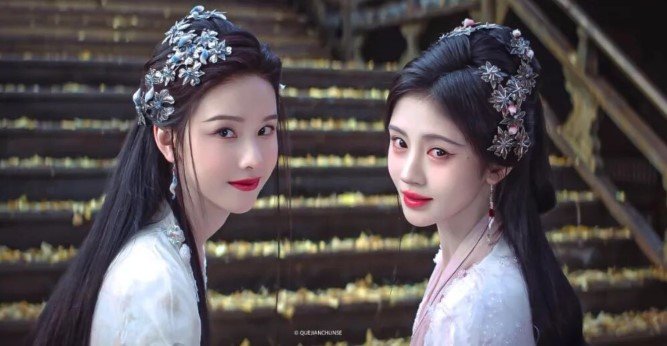
Ju Jingyi: A Deliberate Step Toward Complexity
Ju Jingyi takes on the role of Lu Wuyi, a fox spirit defined by ambiguity and shifting loyalties. Unlike conventional heroines, Lu Wuyi is constructed around contradiction—innocent yet calculating, sincere yet deceptive. This type of character demands fluid emotional transitions and a strong internal logic to maintain coherence amid unpredictability.
In Yue Lin Qi Ji (月鳞绮纪), Ju Jingyi clearly attempts to move beyond her established screen image, which has long been associated with visually polished but emotionally linear roles. Certain scenes—particularly those involving layered interactions such as guarded cooperation or hidden suspicion—show a conscious effort to introduce nuance. The blending of the “fox spirit” identity with her recognizable aesthetic also enhances the character’s visual and atmospheric appeal.
However, the limitations of this transition are equally visible. In moments requiring sharp emotional contrast, the distinctions are not always fully articulated. Shifts between sincerity and calculation, or vulnerability and control, sometimes appear blurred rather than intentional. As a result, the character’s conceptual complexity is not consistently realized on screen.
Taken as a whole, Lu Wuyi represents a transitional role for Ju Jingyi. It signals an awareness of the need to expand beyond repetition, but the execution remains uneven. The performance functions less as a breakthrough and more as an ongoing adjustment—an attempt to bridge the gap between established image and broader expressive range.
Chen Duling: Stability Through Restraint
In contrast, Chen Duling portrays Wu Wangyan, a character defined by rationality and emotional restraint. Where Lu Wuyi operates through unpredictability, Wu Wangyan follows a stable internal logic, maintaining composure even within complex situations. This distinction shapes the entire tone of Chen Duling’s performance.
Throughout Yue Lin Qi Ji (月鳞绮纪), she adopts a controlled and measured approach. Her character often observes rather than dominates, responding with calculated calm rather than overt emotional intensity. This steadiness allows Wu Wangyan to function as a structural anchor within the narrative, particularly in scenes that require clarity and continuity.
Compared to some of her earlier roles, Chen Duling appears more refined here, reducing overt stylization and focusing instead on consistency. This results in a performance that is accessible and broadly acceptable, avoiding major missteps.
Yet this same restraint also limits the character’s impact. In a drama filled with emotional fluctuations and heightened stakes, Wu Wangyan rarely delivers moments of strong memorability. While the performance is stable, it does not push far enough to create standout scenes. The result is a portrayal that is reliable but not particularly striking.
Two Approaches, Shared Limitations
Placed side by side, Ju Jingyi and Chen Duling illustrate two different strategies for navigating career development. One prioritizes expansion, attempting to break away from a fixed image even at the cost of inconsistency. The other prioritizes control, ensuring stability but risking a lack of distinction.
Both approaches carry strengths. Ju Jingyi demonstrates a willingness to challenge herself and engage with more complex character structures, while Chen Duling shows improved control and a clearer understanding of performance rhythm. At the same time, both reveal current limitations—one in fully executing layered characterization, the other in achieving emotional impact.
Career Context: Experimentation vs Consolidation
These patterns align closely with their broader career trajectories. In recent years, Ju Jingyi has maintained steady visibility through leading roles in idol costume dramas, but her projects often follow familiar formulas. This makes it difficult to achieve a defining breakthrough, placing greater importance on roles like Lu Wuyi that attempt to expand her range.
Meanwhile, Chen Duling has experienced a gradual increase in both project volume and role importance, transitioning toward more central positions. However, the absence of a defining role continues to limit her long-term impact. Her performance in Yue Lin Qi Ji (月鳞绮纪) reflects this stage—competent and controlled, but not yet transformative.
Conclusion: A Shared Turning Point
Ultimately, Yue Lin Qi Ji (月鳞绮纪) does not present a clear winner between the two performances. Instead, it highlights a shared condition: both actresses are in the midst of transition. One is moving outward, seeking complexity and variation; the other is refining inward, strengthening consistency and control.
Neither path is complete. Both are still in the process of becoming.
And it is precisely this state—between established identity and future possibility—that defines their current position in the industry.

