In today’s Chinese television landscape, the generation of post-95 actresses has become an undeniable presence. From historical dramas to contemporary series, they increasingly dominate leading roles, reshaping both audience expectations and the industry’s visual culture. Names such as Tian Xiwei (Zhu Yu / 逐玉), Wang Churan (Cheng He Ti Tong / 成何体统), Zhou Ye (Hello 1983 / 你好1983), and Song Zuer (Zhe Yao / 折腰), alongside Zhao Lusi, Esther Yu, Zhang Jingyi, and Zhang Ruonan, represent not only a large cohort, but one defined by a high density of visual appeal.
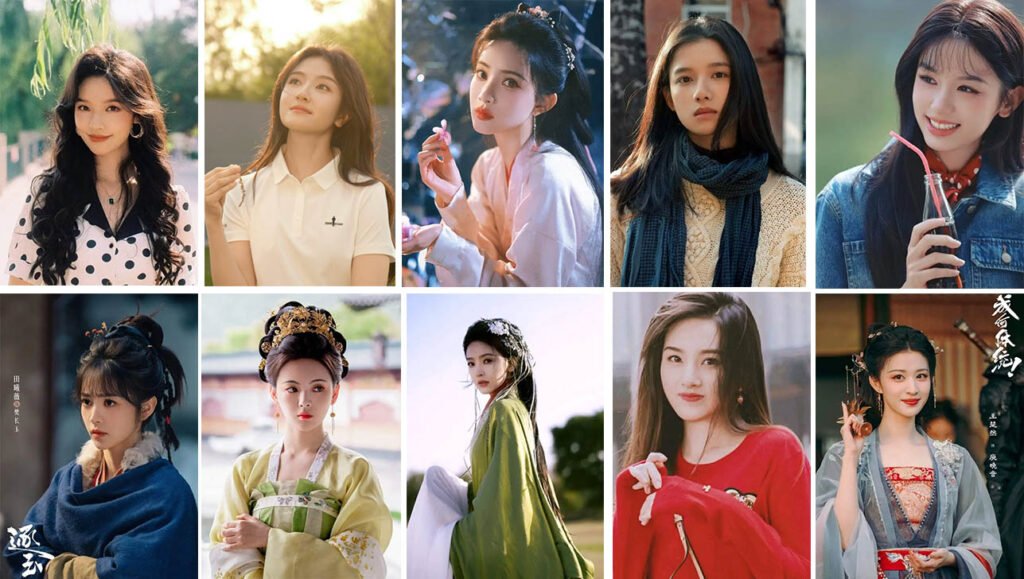
Where earlier generations of actresses were often evaluated primarily through their performances and roles, this group enters the public eye first through appearance and aura. Yet beauty within this generation is far from uniform. It has diversified into distinct categories: the “sweet” archetype represented by Tian Xiwei, Zhao Lusi, and Esther Yu; the soft, girl-next-door charm of Zhang Ruonan; the more striking, mature beauty of Meng Ziyi and Wang Churan; and the cinematic, understated presence of Zhang Jingyi.
This diversity transforms visual competition into something closer to typology. Rather than competing within a single standard of beauty, these actresses occupy different aesthetic spaces, each appealing to different audience sensibilities.
However, once visual appeal becomes merely an entry point, differentiation begins to emerge elsewhere. As their careers progress, some actresses move beyond being “seen” to becoming performers capable of sustaining roles. Song Zuer demonstrates versatility across genres, Zhou Ye reveals adaptability in tone and presence, and Wang Churan builds recognition through consistent visibility and discussion.
Others, however, remain more closely tied to their visual identity. Yang Chaoyue, despite her striking looks, continues to face criticism regarding performance, while Lin Yun’s trajectory reflects the instability that can follow an early breakthrough. These contrasts highlight an emerging divide between “traffic stars” and actors in a more substantive sense.
Taken as a whole, the competition among post-95 actresses is shifting—from a focus on appearance to a contest of positioning. Position here extends beyond popularity; it includes the ability to secure roles, define a screen identity, and maintain consistency in output. Li Landi’s steady growth, Zhang Jingyi’s cultivated artistic image, and Zhang Ruonan’s audience appeal each represent different strategies of positioning within the same generation.
Ultimately, this generation stands at a transitional moment. They enter the industry through visual appeal, but must remain through performance. And in that process, the question is no longer who is the most beautiful, but who can endure—who can move from being seen, to being remembered.

