The premiere of Chinese costume romance drama Liang Chen Mei Jin has once again pushed the topic of “actor-role compatibility” into the spotlight, with much of the discussion centering around Ren Min and whether her appearance fits the traditional image of a historical romance heroine.
In recent years, almost every major costume idol drama has triggered some form of casting controversy. Some viewers criticize actors for not matching the “peerless beauty” descriptions found in original novels, while others blame styling teams for weakening actors’ visual strengths through questionable costume and makeup choices. Following the release of Liang Chen Mei Jin, Ren Min has become the latest actress caught in that cycle of debate.
Adapted from a popular historical romance novel, the drama’s heroine Gu Jinchao is described in the source material as a refined noblewoman with youthful elegance, quiet beauty, and a resilient personality. However, after the drama aired, online discussions quickly focused on Ren Min’s styling rather than the character itself.
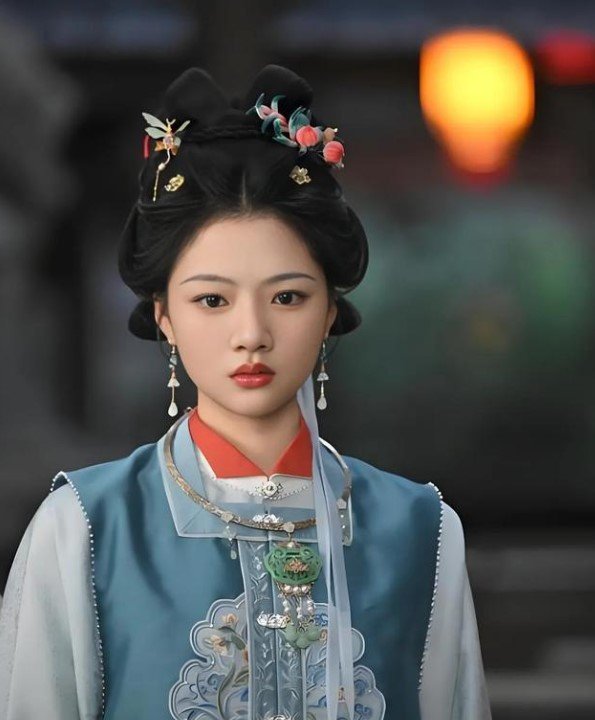
Many viewers argued that the production’s makeup and hair design worked against her natural features. The low-volume hairstyle, flattened hairline styling, and heavy straight brows were criticized for making her face appear fuller and more mature than the youthful image required for the role. Some close-up shots further intensified the criticism, with viewers saying the series failed to capture the delicate “young noblewoman” aura associated with the original character.
The controversy became even more noticeable during scenes shared with actress Huang Yi, who plays another young female character of a similar age range. Because Huang Yi’s styling emphasized lighter colors, higher hairstyles, and softer youthful presentation, many audiences felt the visual contrast unintentionally amplified perceptions that Ren Min appeared older or less aligned with the role’s intended image.
This is not the first time Ren Min has faced similar reactions in the costume drama genre. During the broadcast of The Longest Promise in 2023, discussions surrounding her historical styling also became a major online topic. At the time, viewers criticized the heavy bangs, oversized wigs, and darker styling palette used for her character Zhu Yan, arguing that the production concealed the actress’s natural strengths rather than enhancing them.
Ironically, Ren Min’s reception in modern dramas has generally been far more positive. In Twenty Your Life On, her portrayal of Jiang Xiaoguo received praise precisely because of its realism and relatability. Rather than relying on heavily filtered beauty shots, the character felt grounded and emotionally authentic, which resonated strongly with viewers. Similarly, her emotionally intense performance in The Psychologist gained attention for its strong emotional delivery, with many audiences praising her ability to convey vulnerability and psychological depth.
Because of these contrasts, recent industry discussions have increasingly questioned whether Ren Min may simply be better suited to realistic contemporary dramas rather than traditional fantasy romance projects. Supporters of this view argue that today’s costume idol drama market has become extremely appearance-driven, especially with the rise of younger actresses whose visuals naturally align with the genre’s highly stylized beauty standards. In such an environment, they believe Ren Min’s strengths as a performance-focused actress are often overshadowed by endless visual scrutiny.
Others, however, strongly disagree with the idea that actors should be restricted by audience expectations surrounding physical appearance. Many viewers pointed out that Ren Min previously received praise for her historical role as Princess Fukang in Serenade of Peaceful Joy, where her elegant styling and restrained performance were widely considered highly compatible with the character. To them, the issue lies less with the actress herself and more with inconsistent styling direction and production choices.
The broader debate ultimately reflects a larger issue within the Chinese entertainment industry: modern audiences increasingly expect actors to satisfy two completely different standards simultaneously. On one side, costume idol dramas demand idealized beauty, fantasy-like visuals, and “dream heroine” aesthetics. On the other, realistic dramas prioritize emotional authenticity, relatability, and grounded performances. Very few actors can fully dominate both spaces at the same time.
For Ren Min, who is still relatively young in industry terms, there remains significant room for experimentation and adjustment. Whether she eventually continues exploring historical romance projects or gradually shifts more heavily toward realistic modern dramas, her long-term trajectory will likely depend less on online appearance debates and more on the quality of the projects and performances she chooses moving forward.
At the center of the conversation is a question that extends far beyond one actress or one drama: should audiences judge performers primarily by whether they visually resemble an imagined fictional beauty, or by whether they can ultimately make a character feel emotionally believable on screen?

