As Wu Lin Ling (武林令) continues airing, Huo Linglong, played by Zhang Ruonan, has quickly become one of the drama’s most discussed characters. Unlike the traditional male-centered structure long associated with stories surrounding Zhan Zhao in the Justice Bao universe, this new adaptation clearly attempts to redefine what it means to be an important female figure within a classic wuxia narrative.
Huo Linglong is not an original central character from The Seven Heroes and Five Gallants (三侠五义), yet she has unexpectedly become one of the most vivid and memorable parts of the new series because of her modernized martial arts heroine image and strong personal presence.
Many viewers have noticed that she feels fundamentally different from the women commonly seen in older wuxia dramas. She is no longer written merely as “Zhan Zhao’s love interest,” nor does she exist solely to wait, sacrifice, or emotionally support the male hero. Instead, she possesses independent agency, her own jianghu perspective, and a personal growth trajectory that operates alongside the main storyline rather than beneath it.
In many ways, this shift reflects a broader transformation currently happening within Chinese wuxia aesthetics.

Zhang Ruonan’s Huo Linglong Balances Heroic Spirit And Youthful Energy
Based on the episodes released so far, Huo Linglong is portrayed as a character who combines intelligence, impulsiveness, courage, and emotional vitality. She carries the decisiveness expected from traditional martial arts heroines while still preserving the youthful spontaneity of a young woman discovering her place in the jianghu world.
Compared to many older wuxia female leads — who were often defined primarily by beauty, tragedy, or emotional devotion — Huo Linglong feels more like someone genuinely living within the martial world. She makes mistakes, runs into danger, questions people around her, and gradually matures through experience.
Part of this freshness also comes from Zhang Ruonan herself.
Over the past several years, Zhang Ruonan has mostly been associated with youth dramas, emotional romance stories, and modern urban roles. Whether in Cry Me A Sad River (悲伤逆流成河) or later contemporary projects, she often projected a soft, restrained, and quietly melancholic atmosphere.
Because of that, Wu Lin Ling (武林令) effectively marks her first major entry into a more traditional wuxia setting.
What surprised many viewers is that she does not portray Huo Linglong as a conventional “fragile beauty” heroine. Instead, she adds a relaxed and lively jianghu quality to the character. Especially during scenes alongside Zhan Zhao, the relationship between the two feels less like protector and dependent, and more like two people equally caught inside the same dangerous storm.
That structural shift has become one of the defining features of many newer wuxia adaptations.
From Ding Yuehua To Modern Wuxia Women
When discussing women connected to Zhan Zhao, one classic figure is impossible to avoid: Ding Yuehua.
Within The Seven Heroes and Five Gallants (三侠五义), Ding Yuehua has long been regarded as Zhan Zhao’s most traditional and iconic romantic counterpart. Born into a military family, she is cheerful, capable in martial arts, and famously connected to Zhan Zhao through the classic “martial arts duel leading to engagement” storyline.
Many earlier adaptations preserved this relationship.
In the legendary 1993 version of Justice Bao (包青天), Zhan Zhao was played by Kenny Ho, while Ding Yuehua was portrayed by Tsui Pui Yee. Although her screen time was relatively limited, the immense popularity of Kenny Ho’s Zhan Zhao ensured that the pairing remained deeply rooted in audience memory.
At the time, wuxia heroines were still largely shaped around traditional values such as gentleness, loyalty, emotional sacrifice, and devotion. As a result, Ding Yuehua primarily functioned as an emotional destination within the hero narrative.
Later adaptations gradually began changing that dynamic.
For example, in the 2003 production Zhan Zhao Xia Yi Zhuan, starring Vincent Jiao as Zhan Zhao, female characters were written with more active involvement in the jianghu world. Since Vincent Jiao’s version of Zhan Zhao leaned more toward a romantic and charismatic wandering hero image, the women around him also became emotionally more complex and narratively interactive rather than simply “waiting lovers.”
Today, however, audience expectations surrounding female characters in wuxia stories have changed dramatically.
Modern viewers increasingly expect women in martial arts dramas to possess independent storylines, emotional agency, and personal motivations separate from the male protagonist. That changing expectation forms the foundation for characters like Huo Linglong.
To some extent, she resembles the type of wuxia heroine contemporary audiences now prefer — someone who can participate in investigations, navigate the jianghu world independently, and make emotional and moral choices for herself.
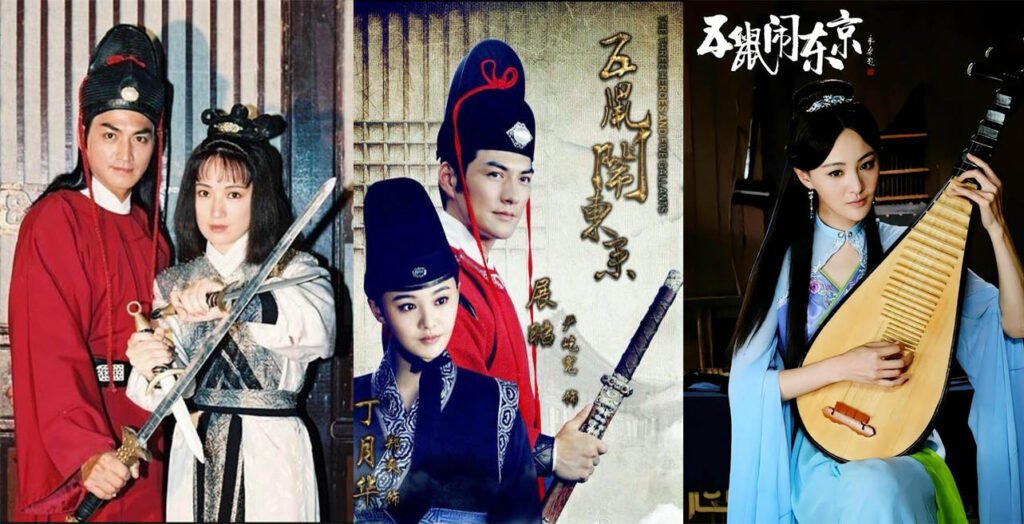
Why Original Female Characters Became More Common In Wuxia Adaptations
Interestingly, compared to Zhan Zhao, adaptations involving Bai Yutang have historically introduced even more original female characters.
The reason is relatively simple: Bai Yutang naturally possesses stronger emotional volatility and romantic dramatic potential. As a character, he is proud, reckless, charismatic, dangerous, and slightly tragic — qualities that make him particularly attractive for expanded emotional storylines.
One well-known example appeared in the 2007 adaptation Bi Xue Dan Xin, where Benny Chan portrayed Bai Yutang. That version significantly amplified the character’s emotional expression and added several original romantic subplots, transforming Bai Yutang from a classic martial arts hero into a more idol-drama-like male lead.
Similarly, many later adaptations of Seven Heroes and Five Gallants introduced entirely original women such as courtesans, female assassins, or aristocratic daughters. These characters often did not exist in the original source material, but were added during adaptation to intensify emotional tension and romantic conflict.
By the 2000s, wuxia television had increasingly shifted toward emphasizing emotional storytelling and “CP chemistry,” making original female characters almost a standard feature of adaptation culture.
However, many of those women ultimately suffered from one major weakness: they existed primarily as narrative tools.
Too often, their purpose was simply to highlight Bai Yutang’s loneliness, charisma, or emotional pain rather than functioning as complete individuals themselves.
This is precisely why Huo Linglong’s popularity feels significant.
Viewers can clearly sense that Wu Lin Ling (武林令) is not merely trying to assign Zhan Zhao a romantic counterpart. Instead, the drama appears genuinely interested in creating a woman capable of entering the jianghu structure itself as an equal participant.
New Wuxia No Longer Treats Women As Mere Companions
Looking back from Ding Yuehua, to the many original women added around Bai Yutang, and now to Huo Linglong, the evolution of female roles within Chinese wuxia dramas becomes very visible.
The wuxia women of the 1990s largely existed in service of male hero narratives. The adaptations of the 2000s shifted toward stronger romantic and emotional storytelling. But the newer generation of wuxia dramas increasingly emphasizes women as individuals with their own value, agency, and narrative significance.
It may still be too early to call Huo Linglong a definitive classic, especially since Wu Lin Ling has only just begun airing. Yet even now, she already represents something noticeably different from many traditional wuxia heroines of the past.
She is not simply the woman waiting for the hero to return.
She is someone willing to step directly into the storms of the jianghu world herself.

